
Provider Pulse Newsletter – June 2026
In this issue of Provider Pulse, we’re sharing important updates, reminders, and resources to support your workflows and help ensure timely, high-quality care for our members.
Thank You for Your Support: Expanding Access, Enhancing Care Through EpicCare Link!
As part of our ongoing efforts to streamline processes and improve efficiency, we recently transitioned to EpicCare Link as the primary platform for authorization and appeal submissions. We appreciate the time and effort providers have invested in adopting this change and helping make the transition a success.
Over the past 90 days, 973 new EpicCare Link accounts have been created, including both new site registrations and individual user accounts. This milestone reflects a strong commitment across our provider network to leverage EpicCare Link for submissions, communication, and real-time access to information.
Your partnership in using EpicCare Link helps reduce administrative burden, improve processing efficiency, and support timely access to care for our members. We are grateful for your engagement and dedication to continuously improving the provider and member experience.
Understanding the Letter of Agreement (LOA) Process
To help ensure members receive timely access to medically necessary services, there may be occasions when care needs to be authorized with a provider outside of the contracted network. In these situations, a Letter of Agreement (LOA) may be pursued. Below is an overview of the process and what providers can expect.
Step 1: Prior Authorization is Required
All requests for services must begin with a prior authorization (PA) submission. This allows our Utilization Management (UM) team to review the medical necessity of the requested service.
Step 2: Network Availability Review
Once the prior authorization request is received, the UM team will review whether the service can be provided by an in-network provider. This helps ensure we are utilizing available network resources whenever possible.
Step 3: Referral to Contracting
If it is determined that no appropriate in-network provider is available, the request is referred to our Contracting team for further review.
Step 4: LOA Outreach and Negotiation
The Contracting team will reach out to the requested out-of-network provider to begin discussions and, when appropriate, establish a Letter of Agreement. The LOA outlines agreed-upon terms, including reimbursement and service expectations, for a specific episode of care.
Key Reminders for Providers
- Submission of a prior authorization is required before an LOA can be considered.
- LOAs are considered only when no appropriate in-network options are available.
- Providers should not begin services until authorization and any necessary agreements are in place.
We appreciate your efforts to support timely, high-quality care for our members. If you have questions about the LOA process, please contact our Provider Relations team.
Reminder: Submit Claim Appeals and Payment Disputes via EpicCare Link
Effective March 1, 2026, post-service provider claim payment disputes and appeals must be submitted through an active EpicCare Link account. Submissions sent via fax or mail are no longer accepted.
If you do not currently have access to EpicCare Link, please check with your office leader (EpicCare Link Site Administrator) to confirm whether your office already has an account. If so, access can be granted to additional team members by your Site Administrator as needed.
If your office leader does not have an EpicCare Link account, your office leader can request access by visiting https://ecl.renown.org/EpicCareLink/common/epic_login.asp and completing the enrollment process. Only one account is required per office, and additional users can be added once the account is established.
Please note that delays in establishing EpicCare Link access will not extend appeal submission timeframes. Advance notice of this change was shared with the provider network on February 1, 2026, to allow adequate time to prepare.
We appreciate your partnership as we transition to a more streamlined and efficient submission process. If you have questions or need assistance with EpicCare Link setup, please contact the Help Desk at 775-982-4042.
Reminder: Referral and Authorization Responsibilities
Hometown Health appreciates your continued partnership in helping ensure our members receive timely, coordinated care. As a reminder, providers should direct members to in-network providers whenever possible. Referrals to non-contracted providers can sometimes result in delays in care and additional administrative steps, which may impact the overall member experience.
Please keep in mind that directing members to in-network providers remains an important part of supporting efficient, high-quality care delivery.
In addition, providers are responsible for obtaining any necessary authorizations and referrals when directing members to specialists or services. This includes, but is not limited to, services such as laboratory work, sleep studies, and genetic testing.
Key Points to Remember
- Authorization Matrices are available on the Provider page of Hometown Health and the EpicCare Link portal homepage.
- As outlined in your Provider Service Agreement, you are required to refer patients only to contracted providers within the Hometown Health network.
- If a referral to an out-of-network provider is necessary because the requested service is not available in-network, please submit a referral through EpicCare Link for review. If the referral is determined to be warranted, our Health Utilization Management team will forward the request to Contracting to coordinate a Letter of Agreement (LOA).
Thank you for your continued commitment to supporting a smooth and positive experience for our members.
Important Update: Attestation and Documentation Required for EpicCare Link Prior Authorizations
Effective June 1, 2026, providers submitting prior authorization requests through EpicCare Link will be asked to confirm that all relevant medical records are included. Please note that copied and pasted clinical notes in the request fields will no longer be accepted, and all supporting documentation should be attached at the time of initial submission.
Reminder: Appointment Access Standards for Members
Hometown Health remains committed to ensuring our members have timely access to care. As part of this effort, Appointment Accessibility Assessments are shared annually with participating providers to help monitor access and support ongoing improvements.
In alignment with NCQA accreditation requirements, Hometown Health regularly reviews adherence to appointment availability standards outlined in the Administrative Guidelines (pages 86–88, Appointment Access). These standards are intended to help ensure members can access routine, urgent, and after-hours care when they need it.
We encourage providers to take a moment to review current scheduling practices and confirm that office operations align with these access standards. Participation in the annual assessment and continued adherence to these guidelines helps support high-quality care across our network.
Thank you for your ongoing partnership and commitment to serving our members.
Cancer Coding Reminder in Recognition of National Cancer Survivor Day
June 7 marks National Cancer Survivor Day, a time to recognize and support those who have faced a cancer diagnosis. As we care for these patients throughout their journey and beyond, accurate documentation and coding play an important role in reflecting their clinical status and ensuring appropriate follow-up care.
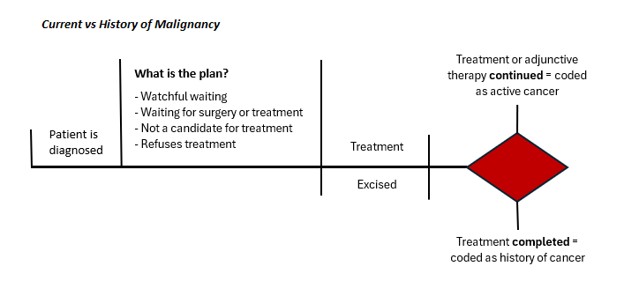
Cancer is one of the most frequently miscoded diagnosis codes according to the OIG. When billing a claim with a cancer diagnosis, it must follow ICD-10 coding guidelines. There is some variation between clinical and coding guidelines in relation to what is considered active cancer versus history of. It is appropriate to code cancer as active during the timeframe between the initial diagnosis and the completion of treatment (either by excision; or by completion of chemotherapy and/or radiation therapy). Untreated cancer that is being monitored (watchful waiting) should be coded as active.
After completion of treatment, it is appropriate to use a ‘history of malignant neoplasm’ code [Z85.-]
*It is important to remember that the use of quantifying language such as, “Rule out, probable, possible or consistent with” cannot be coded as active cancer in the office setting.
The following ICD 10 CM coding guidelines will be helpful in deciding which codes are appropriate:
- When a primary malignancy has been excised but further treatment, such as an additional surgery for the malignancy, radiation therapy or chemotherapy is directed to that site, the primary malignancy code should be used until treatment is completed.
- When a primary malignancy has been previously excised or eradicated from its site, there is no further treatment (of the malignancy) directed to that site, and there is no evidence of any existing primary malignancy at that site, a code from category Z85, Personal history of malignant neoplasm, should be used to indicate the former site of the malignancy.
- Any mention of extension, invasion, or metastasis to another site is coded as a secondary malignant neoplasm to that site.
- Follow-up codes are used to explain continuing surveillance following completed treatment of a disease, condition, or injury. They imply that the condition has been fully treated and no longer exists.
- Follow-up codes may be used in conjunction with history codes to provide the full picture of the healed condition and its treatment. The follow-up code is sequenced first, followed by the history code.
- Z08 Encounter for follow-up examination after completed treatment for malignant neoplasm
- – Personal history of malignant neoplasm
- Should a condition be found to have recurred on the follow-up visit, then the diagnosis code for the condition should be assigned in place of the follow-up code.
- *Leukemia is the only exception, as this condition has specified ‘in-remission’ codes
- Follow-up codes may be used in conjunction with history codes to provide the full picture of the healed condition and its treatment. The follow-up code is sequenced first, followed by the history code.
Wellness Reminder: Staying Hydrated in the Nevada Heat
With summer temperatures rising across Nevada, staying hydrated is more important than ever. Spending time outdoors in the sun increases the body’s need for water, and dehydration does not always begin with thirst—fatigue and headaches are often early signs.
Even mild dehydration can impact concentration and energy levels throughout the day.
Hydration is not just about drinking water. Foods like watermelon (about 92% water) and cucumbers (about 95% water) can also help support daily fluid intake.
As we move into the hottest months of the year, keeping a water bottle nearby and incorporating hydrating foods into your routine are simple ways to stay healthy and energized.
We appreciate all that you do to support our members’ health journeys!

